


👶 The Detail Overlooked by Families Raising Bilingual Children at Home: The Rhythm of English

Hello there! Today on akifhocaingilizce.com, I want to share the details of a new study I've been working on, which is of great interest to parents trying to teach their children English at an early age. ⬇️
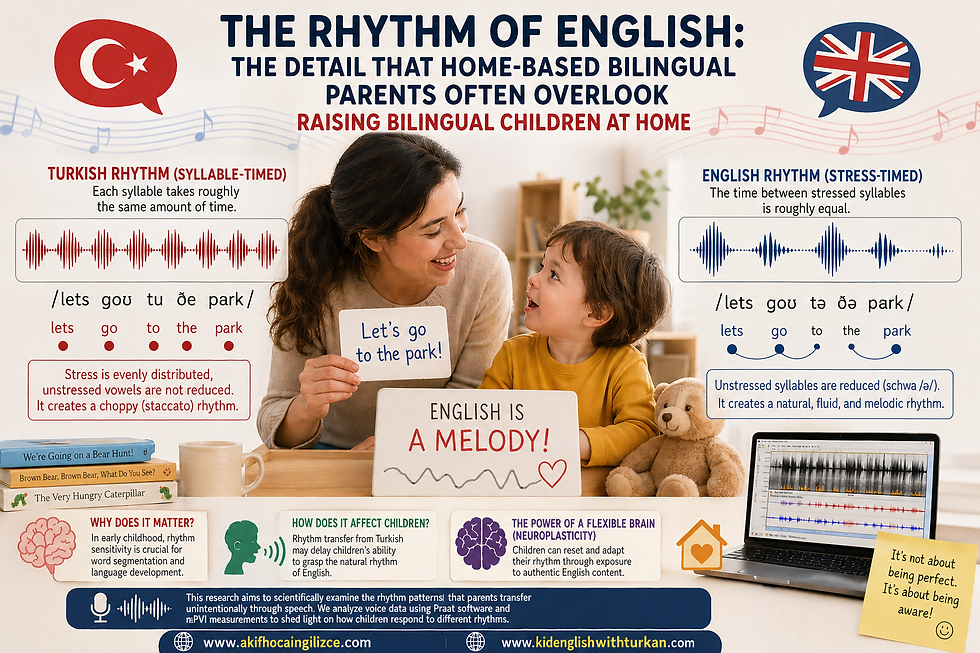
In recent years, "home-based bilingualism" has become increasingly popular in Turkey, especially through helpful platforms like www.kidenglishwithturkan.com. Many parents are trying to raise their children bilingual by providing them with English input at home between the ages of 0-6. We teach our children words, songs, and basic sentences; but what about the "rhythm" aspect?
In this article, based on my own research, we will talk about how parents unknowingly convey the rhythm of English to their children.
⚔️ The Rhythm Battle Between Turkish and English
The root of the issue is that Turkish and English have completely different phonetic rhythms.
Turkish is a "syllable-timed" language: We allocate almost equal time to every syllable when speaking.
English, on the other hand, is a "stress-timed" language: The time between stressed syllables is equal. To maintain this balance, the unstressed vowels in between are reduced or "swallowed" (we call this the "schwa /ə/" sound in English).
As native Turkish speakers, we inevitably transfer the "equally weighted" rhythm of our own language to English when speaking it.
🗣️ A Practical Example: "Let's go to the park"
Let's explain this with a real-life example. Imagine saying "Let's go to the park" to your child.
Our Pronunciation (With Turkish Rhythm): When we say this sentence, we generally put equal stress on every word, reading function words like "to" and "the" completely and clearly without reducing them at all (/lets ɡoʊ tu ðe pɑrk/).
Natural English Pronunciation: A native English speaker, however, says this by reducing the unstressed syllables and with a rhythmic fluctuation (/lets ɡoʊ tə ðə pɑrk/).
This exact situation—where vowels are not reduced and every syllable is read equally—results in English that sounds choppy (staccato).
🤔 So, How Does This Affect Your Child?
The main question I focused on in my research is this: Does this "rhythm transfer" by parents whose native language is Turkish prevent or delay the child's grasp of that natural, stressed rhythm of English?
In early childhood, this sensitivity to rhythm is highly critical for understanding where words begin and end (word segmentation) and for recognizing words.
💡 What Should We Do?
Our goal is absolutely not to say, "Don't speak English with your child if you don't have a perfect accent!" On the contrary, the purpose of this research is to provide much more accurate guidance to families raising bilingual children at home and to produce better educational materials.
Keep doing the best you can. Just don't forget that English has a "melody," and be sure not to neglect exposing your children to plenty of "native English" sources (authentic content, songs, fairy tales).
Parents who want to teach their children English at home and raise them bilingual can visit our website at www.kidenglishwithturkan.com.


Comments